Aniimo System Requirements: Storage Size, PC Specs, and Gameplay Guide (2026)
Aniimo is one of those games that immediately makes you wonder how ambitious a creature-collecting RPG can actually become. At first glance, it is easy to put it in the same conversation as Pokémon or Palworld, but after looking closer at what Pawprint Studio is building, I think that comparison only tells half the story.
Aniimo combines creature collecting with a proper action-RPG combat system, open-world exploration, farming, base customization, online activities, and a particularly interesting mechanic called Twining. Instead of simply ordering your creatures around from a distance, you can actually merge with them and experience the world through their abilities.
That idea alone is enough to make Aniimo stand out.
The PC and console launch is scheduled for September 16, 2026, with mobile versions following on September 23. Since the game is free-to-play, the biggest questions for PC players are fairly straightforward: How demanding is Aniimo? How much storage does it need? And is the gameplay really different enough from other creature-collecting games?
After going through the available technical information and gameplay details, here is what I think you should know before installing it.
Aniimo PC System Requirements
The good news for PC players is that Aniimo does not appear to require some ridiculous enthusiast-level machine just to get through the front door.
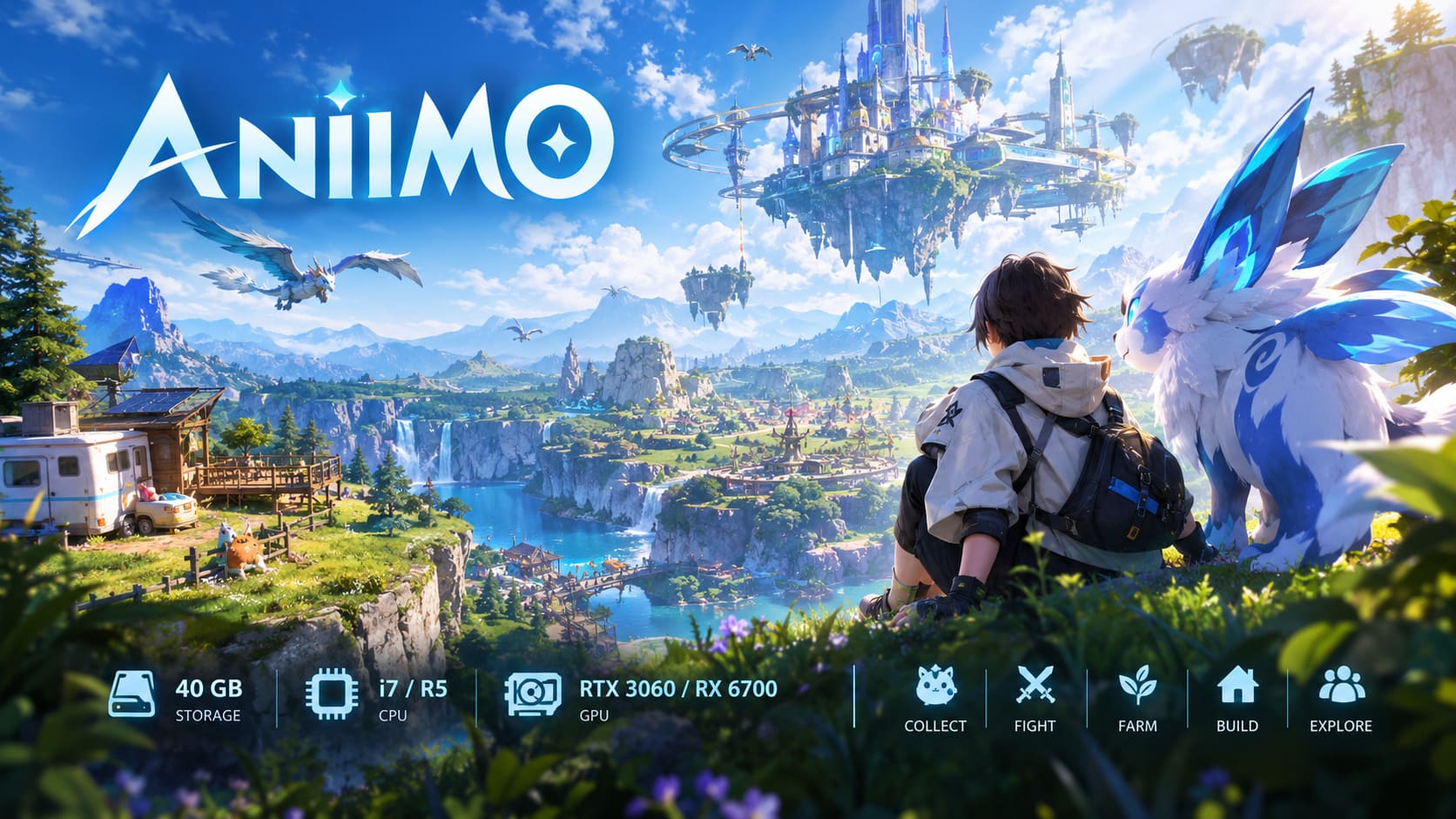
The final specifications are surprisingly reasonable considering the game’s visual ambitions and large seamless environments. The minimum requirements are clearly aimed at older gaming PCs, while the recommended configuration moves into comfortable modern mid-range territory.
| Specification | Minimum | Recommended |
|---|---|---|
| OS | Windows 10 64-bit | Windows 10/11 64-bit |
| CPU | Intel Core i7-4770 / Ryzen 7 2700 | Intel Core i7-10700 / Ryzen 5 5600 or better |
| RAM | 8 GB | 16 GB |
| GPU | GTX 970 / Radeon RX 5600 or RX 6600 | RTX 3060 / Radeon RX 6700 or better |
| DirectX | Version 11 | Version 11/12 support |
| Storage | 40 GB available | 40 GB+ recommended |
| Internet | Broadband connection | Broadband connection |
The minimum specification should be enough to get Aniimo running, but personally, I would not build my expectations around playing a visually ambitious open-world game at maximum settings on hardware sitting exactly at the minimum.
If you have 16 GB of RAM, an RTX 3060-class GPU, and a reasonably modern six-core CPU, you are in a much more comfortable position.
Do You Need an SSD for Aniimo?
Absolutely.
Technically, storage capacity is only part of the question. The type of drive matters just as much.
Aniimo is built around large environments, fast traversal and relatively seamless transitions. That means an old mechanical HDD is a poor match for the game. Even if you technically have enough free space, slower storage can contribute to:
- Texture pop-in
- Longer loading screens
- Stuttering while moving through the open world
- Slower fast travel
- Delayed asset streaming
For me, an SSD should be considered part of Aniimo’s practical requirements, rather than merely a luxury recommendation.
If you still have your game library sitting on a mechanical hard drive, this is a good excuse to finally move it.
How Much Storage Does Aniimo Need?
This is probably one of the most useful things to know before launch.
The official PC listings indicate that Aniimo requires around 40 GB of available storage space. However, the actual download process can be considerably smaller because the files are compressed.
Early launcher reports have placed the initial package somewhere around 18–21 GB, with the installation expanding toward the full 40 GB footprint after unpacking.
That distinction is important.
Don’t look at the download size and assume you only need roughly 20 GB free. Installation processes often require additional temporary space, and having the bare minimum available can turn a simple download into an annoying storage-management session.
My recommendation: keep at least 50 GB of free SSD space available before installing Aniimo. It gives the launcher some breathing room and leaves room for patches.
Console and Mobile Storage
The storage requirements aren’t identical across platforms.
| Platform | Approximate Storage Requirement |
|---|---|
| PC | 40 GB |
| PS5 | 30–35 GB |
| Xbox Series X/S | 30–35 GB |
| Android/iOS | Around 10 GB installed |
| Mobile Installation Space | Roughly 21–25 GB temporary space |
Mobile players should pay particular attention to the difference between installed size and temporary installation space. A phone might eventually need only around 10 GB for the finished game, but significantly more free storage may be required while the installation package is being unpacked.
What Makes Aniimo Different?
This is where Aniimo becomes much more interesting.
There are plenty of creature-catching games now. Some are focused on collecting, others on survival, farming or combat. What caught my attention about Aniimo is that it isn’t trying to make creature collection the only reason to explore its world.
You play as a Pathfinder, travelling across the continent of Idyll and discovering different Aniimo while gradually building your own life and progression.
The game mixes several genres without completely abandoning any of them:
- Open-world exploration
- Creature collecting
- Real-time action combat
- Farming and crafting
- Base building
- Online social activities
- PvP
- Dungeon-style encounters
That combination could either make Aniimo feel wonderfully varied or overly busy. Personally, I’m hoping it lands on the first side because the individual systems seem much more connected than they initially appear.
Twining Could Be Aniimo’s Best Feature
The mechanic I am most interested in is Twining.
Instead of treating your Aniimo as something that simply stands beside you during combat, Twining allows your Pathfinder to merge directly with the creature.
You effectively become the Aniimo.
That changes the entire relationship between player and creature.
Imagine finding an Aniimo with an ability designed specifically for climbing. Instead of watching it perform the movement while your character follows behind, you can actually transform into it and use that ability yourself.
The same principle applies to exploration.
Twining and Exploration
Different creatures can provide different ways of interacting with the environment. Depending on the Aniimo you’re using, you may be able to:
- Glide across large gaps
- Climb difficult terrain
- Dig underground
- Reach hidden locations
- Search for buried resources
This gives creature collection a genuine gameplay purpose beyond simply finding stronger combat statistics.
And that’s important.
In a lot of creature-collecting games, you eventually stop caring about most of the creatures because only a small selection is useful. Aniimo’s traversal mechanics could potentially encourage players to keep different creatures around specifically because they solve different exploration problems.
Real-Time Combat Looks More Hands-On
Combat in Aniimo is another area where the game separates itself from traditional monster-catching RPGs.
Battles are real-time, meaning you’re responsible for movement, positioning, attacks and dodging rather than simply selecting an ability from a menu.
That immediately gives the game a different rhythm.
You can attack enemies directly, look for openings and approach encounters more carefully. Sneaking behind opponents can even provide a 1.5x capture-rate bonus, which gives stealth an actual reason to exist rather than being a cosmetic feature.
I particularly like this approach because it makes catching creatures feel like part of the action rather than something completely disconnected from it.
Bosses and Alpha Aniimo
The open world isn’t just populated by basic creatures waiting to be collected.
Aniimo also features larger Alpha Aniimo encounters, including enemies such as Alpha Turbo, Tubster and Stellarys.
These fights appear designed around positioning, timing and exploiting elemental weaknesses. You’ll also have to think about which Aniimo form is best suited to the encounter rather than simply using the strongest creature in your collection.
That could become one of the most rewarding parts of the game if the elemental system is properly balanced.
Idyll Isn’t Just About Fighting
One thing I appreciate about Aniimo is that the developers haven’t built the entire experience around combat.
When you’re tired of fighting monsters, you can head back to your Homeland and focus on building a more relaxed life.
Your customizable RV functions as a mobile base while exploring the world, and your Homeland becomes a place where you can build, decorate and farm.
The life-sim side includes:
Farming: Plant crops, harvest resources and use them for crafting and consumables.
Building: Arrange structures, furniture and decorations to create your own personal settlement.
Aniimo Workers: Assign captured creatures to help around your Homeland, turning the area into a more active little community.
This is actually one of the features I think could make Aniimo surprisingly addictive.
There is something satisfying about leaving an open-world boss fight, returning home, checking your crops and rearranging your base. Games that allow players to alternate between high-intensity combat and relaxed progression tend to have much better long-term pacing.
The Sky Metropolis and Multiplayer Side
Aniimo also has a social component that goes beyond simply playing alongside another player.
A floating metropolis in the sky acts as a major social hub where Pathfinders can meet, interact, trade, join guilds and participate in competitive activities.
PvP arenas are also part of the experience, giving players something to work toward after they’ve explored the PvE side of the game.
The cross-platform approach is particularly ambitious.
Dimraeth Save File Location: How to Find, Backup, and Transfer Save Data on Windows PC
Cross-Progression Across PC, Console and Mobile
Aniimo is designed around shared progression rather than forcing players to maintain completely separate characters on every platform.
In theory, that means you could play on your PC at home, continue on a PlayStation 5 or Xbox, and then check your Homeland or progression from a mobile device.
For a free-to-play game, this makes a lot of sense.
Players increasingly switch between devices depending on where they are, and losing progression every time you change platforms is one of the fastest ways to make a game feel outdated.
Regional servers should also help maintain reasonable connection quality, although actual performance will naturally depend on your location and internet connection.
Is Aniimo Worth Playing at Launch?
Based on everything currently known, Aniimo has much more going for it than simply being another Pokémon-style creature collector.
The 40 GB PC installation isn’t particularly intimidating, and the recommended hardware is reasonable enough that you don’t need a flagship gaming PC to enjoy it. The SSD requirement is the main thing I would take seriously, especially because open-world streaming can expose slow storage very quickly.
But the real selling point isn’t the system requirements.
It’s the combination of Twining, real-time combat, open-world traversal and the cozy Homeland system.
I’m especially curious to see whether Twining becomes a genuinely important part of exploration or ends up being a flashy gimmick that players eventually ignore. If Pawprint Studio manages to make different Aniimo useful both in combat and for navigating Idyll, collecting creatures could feel much more meaningful than simply filling out a catalogue.
For PC players preparing for the September 16 launch, my advice is simple: install Aniimo on an SSD, keep at least 50 GB of free space available, update your GPU drivers and don’t underestimate the importance of 16 GB of RAM.
The hardware requirements are accessible enough. Now the big question is whether the actual game can live up to the unusually ambitious mix of genres.
If it can, Aniimo might be one of the more interesting creature-collecting RPGs to arrive in 2026.