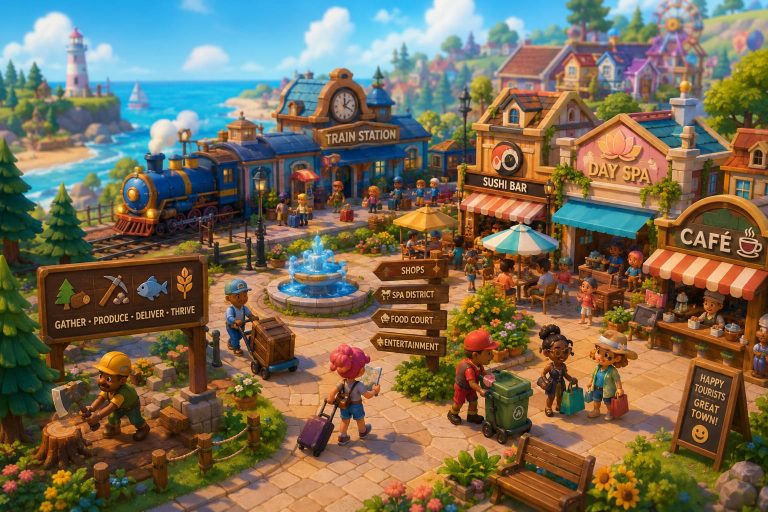
Town to City Spring Update Review: Cherry Blossoms and Performance Improvements
I’ve been spending a lot of time lately in Town to City, and this Spring Update, also known as the Cherry Blossom Update, honestly surprised me more than I expected.
As someone who regularly streams cozy city builders and usually keeps expectations grounded during Early Access, I didn’t think a seasonal patch would actually feel like a turning point for the game. But this one kind of does, especially with the 1.0 release coming up on May 26, 2026.

This isn’t just a cosmetic drop. It’s a mix of visual expansion, quality-of-life improvements, and some serious backend optimization that you actually feel while playing. And from a streamer perspective, that combination matters a lot because both performance and aesthetics directly affect how the game plays out live.
Town to City Review: Early Access and 1.0 Tourism Update Impressions
Cherry Blossom Pack: A Full Atmosphere Shift
The Cherry Blossom Pack is the obvious highlight, and it immediately changes the mood of any city you’re building. What used to feel like a standard medieval-inspired voxel settlement suddenly turns into something much more atmospheric and almost meditative in tone.
What stood out to me most was how quickly the environment transforms just by layering in a few assets. You’re not just placing decorations—you’re reshaping the identity of entire districts.
Main Decorative Additions
- Cherry Blossom Tree and Large Cherry Blossom Tree
- Bamboo patches and single bamboo placements
- Stone lanterns for ambient lighting
- White stone arches and modular walls
- Red wooden bridge for water crossings
- Cherry blossom ground paint for terrain coverage
The ground paint feature is honestly more impactful than it sounds on paper. It allows you to simulate falling petals across paths and open spaces, which gives entire neighborhoods a softer visual identity. It’s one of those features where you don’t really plan around efficiency anymore—you start building for atmosphere.
Streaming this update also changed how my audience interacted with the game. Instead of focusing on optimization or layout efficiency, chat started suggesting aesthetic themes like “Japanese garden district” or “peaceful riverside zone,” which tells you everything you need to know about how this pack affects creativity.
Town to City 1.0 Tourism Update Review — Cozy City Builder Gets a Big Upgrade
Building Experience: Slower, But More Intentional
From a gameplay perspective, this update pushes players into a slower and more deliberate building style. I found myself spending much more time adjusting layouts for visual flow rather than just maximizing space usage or productivity metrics.
The bamboo structures in particular are surprisingly flexible. They work as natural separators between districts, which makes city planning feel more organic rather than strictly grid-based or efficiency-driven.

A simple combination I kept returning to was bamboo-lined rivers, red bridges crossing narrow waterways, and lantern-lit walking paths under cherry blossom canopies. It creates a loop where you’re not just building a city—you’re designing a space people would actually want to walk through.
Performance Upgrade: The Most Important Part of the Patch
While the visual content gets most of the attention, the real foundation of this update is the performance improvement. And from my experience running larger cities in previous versions, this is where the game needed the most work.
Before this update, scaling cities often meant dealing with noticeable CPU strain. As populations grew and systems stacked up, performance would degrade, especially when zooming out or speeding up simulation time.
Now, the difference is clearly noticeable.
What Feels Better After the Update
- Smoother camera movement across large cities
- Reduced stuttering during high-density simulation
- Faster response when placing complex structures
- More stable frame pacing during fast-forward gameplay
The transition to a heavily customized Unreal Engine 5.7 setup appears to be a major factor here. It seems specifically tuned for voxel rendering and large-scale AI simulation, which is exactly what this type of city builder needs to scale properly.
Performance Comparison Overview
| Category | Before Update | After Update |
|---|---|---|
| Large City Performance | Frequent stutters at high density | Much smoother and more stable |
| Camera Movement | Occasional lag spikes | Fluid and responsive |
| Simulation Load | Heavy CPU pressure in late game | Improved distribution and stability |
| Building Placement | Minor delays in dense areas | Faster and more consistent |
| Overall Stability | Occasional long-session instability | Noticeably more reliable |
Bug Fixes and System Improvements That Actually Matter
What I appreciate about this patch is that the bug fixes aren’t just filler. They address real systems that were either broken or being unintentionally exploited by players.

One of the more interesting fixes involved class-based job assignments, where certain citizen roles could incorrectly be assigned to research-related buildings under specific upgrade conditions. That kind of issue might sound minor, but in a simulation-heavy game, it can ripple into economic imbalance.
Other fixes included UI alignment improvements in the settings menu, icon corrections for bridge variations, and a proper fix for farmland placement logic that previously allowed players to exploit terrain painting to bypass agricultural limits.
How This Update Impacts Late-Game Cities
The biggest long-term change here is how the game handles scale. Large cities no longer feel like they are pushing against engine limitations as aggressively as before. Instead, expansion feels more natural and less technically constrained.
From my experience, zooming across dense districts now feels smoother, and switching between heavily populated and low-density zones doesn’t cause the same performance hesitation it used to. That alone makes a huge difference in how enjoyable long play sessions are.
This matters even more when you consider where the game is heading. With tourism systems, hotels, and expanded regional maps planned for 1.0, stability at scale isn’t optional—it’s essential.
Final Thoughts: A Strong Step Before 1.0
This Spring Update feels like a transition point rather than just another content drop. It combines meaningful visual additions with foundational technical improvements that directly support the game’s long-term direction.
As a streamer, I value updates that not only add new content but also make existing systems more enjoyable to interact with live. This patch does both. The Cherry Blossom content encourages creativity and aesthetic building, while the performance improvements ensure that larger cities remain playable and stable.
It’s not a perfect update, but it feels like a necessary one. More importantly, it feels like the developers are genuinely preparing the game for its full release instead of just stacking features.
If the upcoming 1.0 launch builds on this foundation, Town to City could easily become one of the stronger entries in the cozy city builder genre right now.