Control Resonant PC System Requirements: Can Your Rig Handle Remedy’s Next-Gen Ray Tracing?
The Remedy Connected Universe is getting ready to bend reality all over again, and Control Resonant looks like it could become another brutal test for PC hardware. As the follow-up to 2019’s Control, the game is moving beyond the strange corridors of the Oldest House and into a much larger, distorted version of Manhattan. This time, players take control of Dylan Faden, Jesse Faden’s brother, as he faces a new paranatural nightmare filled with unstable environments, supernatural powers, and the kind of visual effects Remedy has become famous for.
I have always liked Remedy games for one simple reason: they make my PC sweat. Control was already one of those games where turning on ray tracing could make you stare at your GPU usage with a mixture of excitement and concern. Alan Wake 2 pushed that idea even further, and Control Resonant appears ready to continue that tradition with an updated Northlight Engine, heavier lighting effects, more detailed environments, and significantly more demanding rendering technology.
So, what kind of PC will you actually need? The answer depends heavily on whether you simply want to play the game at high settings or whether your goal is to experience its most demanding ray tracing and path tracing features. The basic requirements look surprisingly reasonable, but the hardware needed for the full visual showcase is a very different story.
How to Fix Twisted Tower Crash on Launch and Startup Freezing in Windows 11 (2026 Guide)
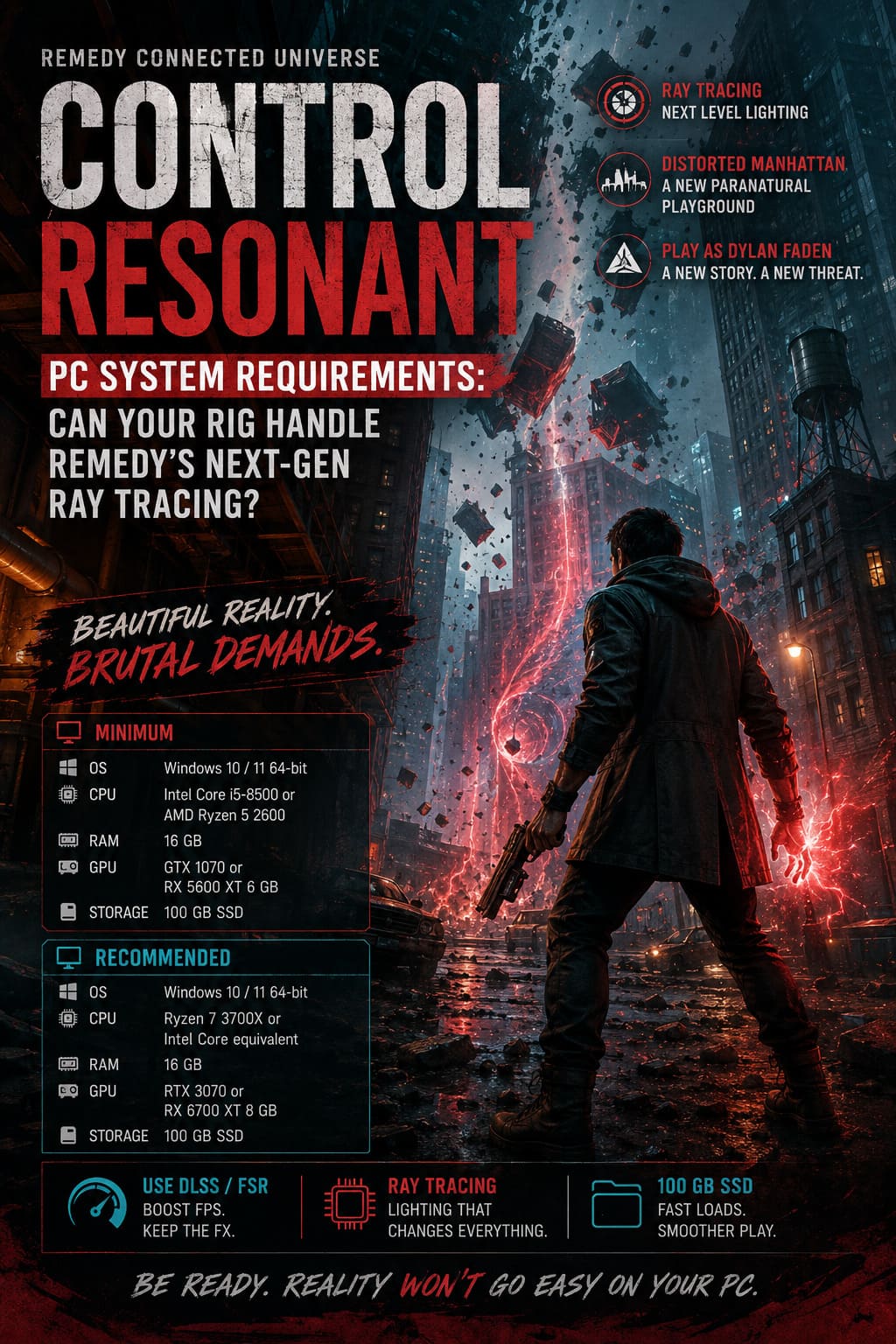
Control Resonant Minimum PC Requirements
The minimum specifications are actually less frightening than I expected for a modern Remedy production. If you have kept an older gaming PC alive for several years, there is still a reasonable chance that you will be able to run the game without immediately reaching for an upgrade.
| Component | Minimum Requirement |
|---|---|
| OS | Windows 10 / 11 64-bit |
| CPU | Intel Core i5-8500 or AMD Ryzen 5 2600 |
| RAM | 16 GB |
| GPU | NVIDIA GeForce GTX 1070 or AMD Radeon RX 5600 XT 6 GB |
| Storage | 100 GB SSD |
The important part here is the GTX 1070 / RX 5600 XT class of hardware. These GPUs are definitely not new, but they remain capable 1080p cards for people who are willing to make a few compromises. I would expect this tier to target something around 1080p with Low or Medium settings, probably somewhere in the 30 FPS range depending on the final optimization and the exact scene.
There is one major catch, though: do not expect meaningful ray tracing performance from the minimum configuration. Older GPUs simply are not designed for the workload that modern RT effects can generate. You might be able to launch the game and enjoy the campaign, but the fancy lighting showcase is going to be reserved for considerably stronger hardware.
The SSD requirement is also something I would take seriously. A 100 GB installation is not unusual for a modern AAA game, but Remedy’s environments can involve huge amounts of geometry, effects, textures, and constantly changing world data. I would personally avoid installing Control Resonant on a mechanical hard drive even if the game technically allowed it. Long loading screens and streaming-related stutters are not how I want to experience a game built around reality constantly falling apart.
Recommended Control Resonant System Requirements
The recommended configuration is where things start becoming much more interesting for mainstream PC gamers.
| Component | Recommended Requirement |
|---|---|
| OS | Windows 10 / 11 64-bit |
| CPU | AMD Ryzen 7 3700X or Intel Core equivalent |
| RAM | 16 GB |
| GPU | NVIDIA GeForce RTX 3070 or AMD Radeon RX 6700 XT 8 GB |
| Storage | 100 GB SSD |
An RTX 3070 or RX 6700 XT should provide a much more comfortable experience than the minimum tier. This is the kind of hardware I would want for High settings at 1080p or 1440p, especially if the game offers good upscaling options.
Sixteen gigabytes of RAM should also be enough for most players, although I would not be surprised if 32 GB eventually became the more comfortable choice for people who like running browsers, Discord, recording software, and other applications in the background. The CPU requirements are not outrageous either, which suggests that Remedy is putting a particularly heavy emphasis on GPU rendering.
That said, there is an important distinction between running Control Resonant well and running every visual feature at maximum quality. An RTX 3070 is perfectly respectable hardware, but I would not buy one today specifically because I wanted to play a modern Remedy game with maximum ray tracing. Its 8 GB VRAM capacity is another potential limitation once textures, RT effects, and higher resolutions are combined.
Ray Tracing Changes the Hardware Conversation
This is where the requirements become much more interesting.
Remedy has a reputation for making ray tracing more than a checkbox buried somewhere in the graphics menu. In Control, RT reflections, transparent reflections, and global illumination could dramatically change the atmosphere of certain areas. Alan Wake 2 pushed the technology even harder, and Control Resonant looks positioned to continue that approach.
If you want ray tracing at a playable frame rate, I would personally start looking above the official recommended GPU tier.
A More Realistic Ray Tracing Target
For 1080p or 1440p gaming with moderate ray tracing, something around an RTX 3080, RTX 4060 Ti, or Radeon RX 7700 XT would make much more sense. Even then, I would expect upscaling to be part of the equation rather than something you simply ignore.
This is one of those situations where DLSS Quality or FSR Quality can make a huge difference. Instead of forcing the GPU to render every pixel natively, the game can render internally at a lower resolution and reconstruct the final image. When the implementation is good, the visual difference can be surprisingly small while the performance improvement is substantial.
For me, that is a much better compromise than simply turning ray tracing off. If the lighting technology is one of the things that makes Control Resonant special, I would rather use high-quality upscaling and keep some RT effects enabled than run native resolution with everything disabled.
Path Tracing Could Be Extremely Demanding
Path tracing is a completely different beast.
If Control Resonant follows the visual direction established by Remedy’s recent Northlight projects, the most aggressive lighting modes could put even powerful GPUs under serious pressure. Full path tracing essentially asks the hardware to simulate a much more comprehensive lighting environment, including reflections, indirect illumination, shadows, and other interactions that traditional rasterization handles through approximations.
For 1440p or 4K gaming with heavy ray tracing or path tracing, I would be looking toward GPUs such as the RTX 4070 Ti Super, RTX 4080-class hardware, or newer high-end RTX 50-series cards. AMD’s RX 7900 XTX remains a powerful rasterization GPU, but NVIDIA hardware generally has an advantage once the workload becomes heavily dependent on ray tracing.
The exact performance will obviously depend on the final PC build, graphics settings, driver optimization, and the game’s launch version. I would not treat unofficial benchmark predictions as guaranteed numbers. Remedy games can behave very differently from one scene to another, especially when physics, destruction, particles, volumetric lighting, and complex environments all appear on screen simultaneously.
DLSS, FSR and Frame Generation Will Matter
Modern high-end PC games are increasingly designed around reconstruction technologies, and Control Resonant is unlikely to be an exception. NVIDIA DLSS, AMD FSR, and Intel XeSS can all help reduce the enormous rendering workload created by high resolutions and advanced effects.
Frame Generation is particularly interesting for players with compatible hardware. Instead of relying entirely on traditionally rendered frames, the technology generates additional frames between them, making gameplay appear substantially smoother. It does not magically turn a weak GPU into a high-end card, but when the underlying frame rate is already reasonable, it can make demanding graphical settings much easier to live with.
I would still prioritize a strong base frame rate before switching on every frame-generation feature available. If a game is struggling to maintain 30 FPS before frame generation, the result is not going to feel the same as starting from a stable 60 FPS and building on top of it.
What PC Should You Actually Have?
If I were building or upgrading a PC specifically for Control Resonant, I would divide the targets into three simple categories.
- 1080p budget experience: GTX 1070 / RX 5600 XT-class GPU, 16 GB RAM and a decent six-core CPU.
- 1440p High settings: RTX 3070 / RX 6700 XT-class GPU or better, preferably with 32 GB RAM and a fast NVMe SSD.
- Ray tracing and high-resolution gaming: RTX 4070 Ti Super / RTX 4080-class hardware or newer, paired with a strong modern CPU and 32 GB RAM.
The second category is probably the sweet spot for most players. You do not necessarily need an absurdly expensive PC to enjoy the game, and spending thousands just to chase maximum ray tracing is difficult to justify unless you genuinely care about visual quality.
For 4K enthusiasts, however, the story changes. Native 4K combined with aggressive ray tracing is one of the hardest workloads you can throw at a modern gaming GPU. In that situation, DLSS or FSR becomes less of an optional convenience and more like an essential part of the performance strategy.
Why the SSD Requirement Matters More Than It Looks
One detail I would not overlook is the storage requirement.
A fast SSD can make a huge difference in modern open-world and semi-open-world games because assets can be streamed much more quickly as the player moves through the environment. Control Resonant’s warped Manhattan setting should provide plenty of opportunities for this technology to matter.
If you are still using an HDD for your game library, this could be a good excuse to finally move your most demanding games to an SSD. A decent NVMe drive is not going to increase your average FPS dramatically, but it can improve loading times and reduce the chance of streaming-related stutters.
Is 16 GB RAM Still Enough?
Technically, yes, based on the listed requirements. Personally, I would aim for 32 GB if you are building a new gaming PC in 2026.
The difference is not necessarily going to double your FPS. Instead, extra memory gives Windows and the game more breathing room, especially when you have Discord, Chrome, recording software, launchers, or other background applications running at the same time.
If you already own a system with 16 GB and the rest of your hardware is strong enough, I would not rush out and upgrade solely because of Control Resonant. But if you are buying new hardware, 32 GB is the configuration I would choose.
My Take on the Control Resonant PC Requirements
What I like about these requirements is that the entry point does not appear completely ridiculous. You do not need a flagship GPU just to launch the game, and players with older hardware should still have a route into Dylan Faden’s story.
The interesting part is the gap between the minimum/recommended requirements and the hardware needed for the game’s most ambitious visuals. That gap could be enormous once path tracing, high resolutions, and maximum settings are combined. This is very much in line with what we have seen from Remedy before.
If you already have an RTX 3070 or RX 6700 XT, I would not panic about upgrading. Start with High settings, use a sensible upscaling preset, and see how the actual game performs before spending money. If your dream is 4K, heavy ray tracing, and consistently high frame rates, though, you should be prepared to spend considerably more.
For me, the biggest thing to watch will not even be the official requirements. It will be real-world PC performance after launch. Remedy’s Northlight Engine can produce some incredible visuals, but those visuals come with a price. If Control Resonant manages to deliver the atmosphere of the original game while making its huge supernatural environments run smoothly, that will be a much bigger victory than simply having another impressive graphics benchmark.