Meccha Chameleon Guide: Hiding and Seeking Tips for Beginners
When I first launched Meccha Chameleon, I expected another goofy hide-and-seek party game where players transform into random furniture and hope nobody notices them. Five minutes later, I realized I was completely wrong.
This game takes the entire prop hunt formula, throws it into a blender, and replaces it with something far more creative. Instead of becoming a chair, a lamp, or a suspicious-looking cardboard box, you’re handed a blank character model and told to become part of the map itself. The result is equal parts genius, chaos, and psychological warfare.
After spending dozens of matches watching brilliant disguises and embarrassingly obvious mistakes, I’ve noticed that most newcomers struggle for the same reasons. They focus on colors while ignoring shapes. They panic when playing Seeker. They underestimate how much positioning matters.
If you’re tired of being discovered in the first minute or missing obvious Hiders standing right in front of you, this guide is for you.
Why Meccha Chameleon Feels Different From Other Hide-and-Seek Games
Most games in the genre rely on transformation mechanics. You become an object and try not to look suspicious.

Meccha Chameleon asks a much harder question:
Can you trick another human being into believing you aren’t there at all?
That’s where the magic happens.
The painting system gives players almost unlimited freedom. Every round becomes a battle of creativity rather than memorization. One player may perfectly recreate a wall texture, while another disguises themselves as part of a floor pattern or blends into decorative artwork.
The best hiding spots aren’t always hidden.
They’re often sitting directly in the center of a room.
Understanding How Matches Actually Work
Before worrying about advanced techniques, it helps to understand what makes a successful round.
A standard match follows three simple stages.
| Phase | What Happens | Main Objective |
|---|---|---|
| Team Assignment | Players become Hiders or Seekers | Understand your role immediately |
| Preparation Time | Hiders paint and position themselves | Create the best camouflage possible |
| Search Phase | Seekers enter the map | Find every hidden player before time expires |
Simple on paper.
Completely chaotic in practice.
The pressure changes dramatically depending on your team. Hiders have limited time to create convincing disguises, while Seekers are constantly fighting the clock.
That tension is exactly what makes the game so addictive.
Hider Fundamentals: Stop Thinking About Color Alone

One mistake appears in almost every beginner lobby.
Players find a blue wall.
They paint themselves blue.
They get caught.
Then they wonder why.
Color matching is only one small piece of effective camouflage.
Human eyes naturally detect shapes before details. Even if your colors are perfect, your silhouette can instantly expose you.
The strongest disguises combine multiple elements:
- Color matching
- Texture matching
- Shape disruption
- Smart positioning
- Proper pose selection
Ignore one of these factors and your disguise starts falling apart.
The Secret Power of Breaking Your Silhouette
Veteran Hiders rarely create perfectly clean paint jobs.
That sounds strange at first.
Shouldn’t perfect painting be the goal?
Not necessarily.
Imagine standing against a tiled wall. Instead of painting yourself one uniform shade, divide your body into sections that continue the tile pattern. Let lines travel across your torso, arms, and legs.
When done correctly, the human eye stops recognizing a character model and starts seeing part of the environment.
This technique works exceptionally well near:
- Tile floors
- Brick walls
- Bookshelves
- Decorative panels
- Industrial structures
I’ve watched Seekers walk past players multiple times simply because their brains registered the area as environmental clutter.
The Best Hiding Spots Are Usually Not Hidden
This is probably the biggest lesson I learned.
Corners are overrated.
Dark shadows are overrated.
Behind furniture is overrated.
Experienced Seekers check those locations first.
Instead, focus on visually noisy environments.
A colorful mural.
A cluttered storage room.
A wall covered in signs.
A plant-filled greenhouse.
These locations overload visual processing and make small imperfections much harder to notice.
Whenever a room contains a lot of information, your chances of blending in increase dramatically.
Posing Can Make or Break a Perfect Camouflage
Many players spend their entire preparation phase painting and then rush through pose selection.
That’s a huge mistake.
Imagine creating an amazing disguise against a thin support pillar but leaving your character standing in a relaxed wide stance.
The paint may be flawless, but your body shape immediately gives you away.
Always ask yourself:
What shape does the environment need me to become?
Tall vertical structures benefit from straight poses.
Low objects often favor crouched positions.
Irregular clutter may require angled stances.
The goal is to reduce visual depth and make your character appear flatter than it actually is.
Lighting Is the Silent Killer of Good Disguises
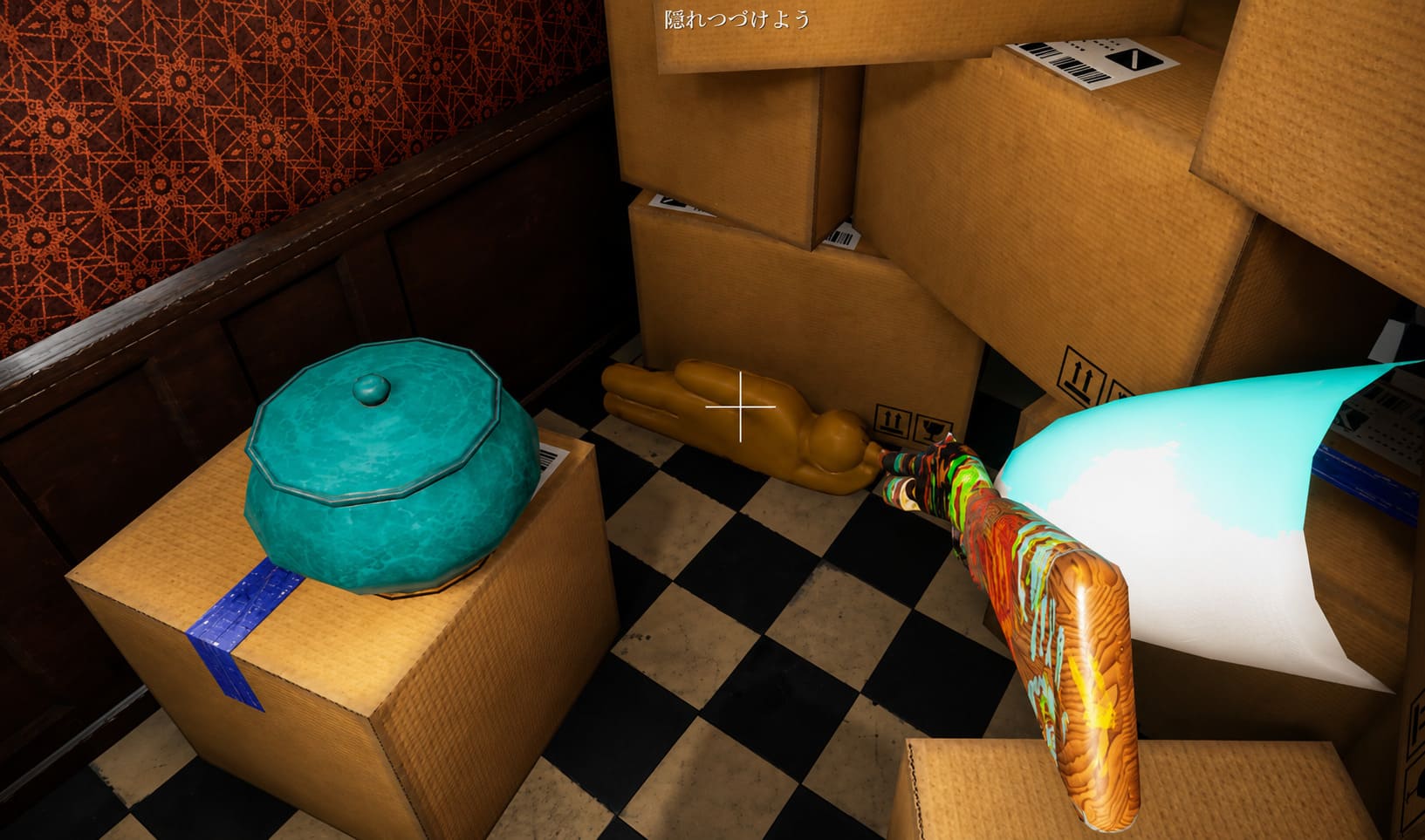
I’ve seen incredible paint jobs fail because players ignored lighting.
The environment isn’t just made of colors.
It’s made of shadows.
A bright texture placed inside a dark hallway creates instant contrast. Even if the pattern matches perfectly, the brightness level exposes you.
Before locking in your hiding spot, examine:
- Shadow direction
- Ambient brightness
- Reflective surfaces
- Nearby light sources
Good camouflage adapts to lighting conditions just as much as texture.
How Great Seekers Think Differently
Most beginner Seekers are basically speedrunners.
They sprint around the map.
They panic.
They randomly attack objects.
Then they wonder why nobody gets found.
Strong Seekers operate more like detectives.
They search for inconsistencies.
They don’t ask:
“Where could somebody hide?”
They ask:
“What doesn’t belong here?”
That mindset changes everything.
Search From Angles, Not Straight Lines
This tactic instantly improves your performance.
Many Hiders can create convincing disguises when viewed head-on.
Side angles tell a different story.
Because player models have physical depth, they often create subtle protrusions from otherwise flat surfaces.
Whenever possible:
- Approach walls diagonally
- Circle suspicious structures
- Check objects from multiple perspectives
A disguise that looks perfect from one angle can completely collapse from another.
Learning Maps Is a Massive Advantage
Knowledge wins games.
Every experienced Seeker eventually develops a mental map of the environment.
They know:
- Where furniture normally sits
- How decorations are arranged
- Which walls contain artwork
- What structures belong in each room
As a result, anything unusual immediately attracts attention.
When you’re learning a new map, spend time simply observing.
Don’t focus only on winning rounds.
Study the environment.
The more familiar you become with the map itself, the easier it becomes to detect players hiding within it.
Why Team Coordination Matters More Than Raw Skill
One thing many players overlook is communication.
A coordinated Seeker team can clear areas dramatically faster than individuals wandering independently.
Instead of overlapping searches, divide responsibilities.
One player checks walls.
Another examines floors.
Someone else watches elevated structures.
This systematic approach eliminates blind spots and prevents Hiders from exploiting confusion.
The difference between organized and disorganized teams is enormous.
Advanced Community Strategies Worth Trying
After spending time watching community matches and high-level gameplay sessions, several clever tactics stand out.
The Decoy Strategy
One Hider intentionally creates a disguise that looks almost convincing.
Not terrible.
Not perfect.
Just suspicious enough.
Seekers often become obsessed with investigating that player while stronger disguises remain untouched elsewhere.
Controlled Chaos
Certain maps contain clusters of props and environmental clutter.
Even an imperfect disguise becomes significantly stronger when surrounded by visual noise.
The environment does half the work for you.
Group Camouflage Experiments
Some of the funniest matches happen when multiple Hiders coordinate a single giant pattern.
A wall mural.
A geometric design.
A fake advertisement.
The results aren’t always practical, but they’re often surprisingly effective.
Common Mistakes New Players Should Avoid
The fastest way to improve is eliminating bad habits.
Avoid these beginner errors:
| Mistake | Why It Fails |
|---|---|
| Using only one color | Shapes remain obvious |
| Hiding exclusively in corners | Seekers check them first |
| Ignoring lighting | Contrast exposes you |
| Constant camera movement | Creates visible motion |
| Rushing paint jobs | Small details matter |
| Searching randomly as Seeker | Wastes valuable time |
Fixing just two or three of these mistakes can dramatically improve your win rate.
Gothic 1 Remake Console Commands: How to Activate Marvin Mode and Full Cheat List (2026 Guide)
Final Thoughts
Meccha Chameleon succeeds because it transforms hiding into an art form. Every round becomes a contest between creativity and observation, and that’s something few multiplayer games manage to achieve.
The longer you play, the more you realize that victory rarely comes from luck. Great Hiders understand visual psychology. Great Seekers understand environmental consistency.
If you’re new to the game, don’t worry about creating flawless disguises immediately. Experiment with patterns. Study map layouts. Learn how different poses interact with the environment.
Most importantly, pay attention to why you got caught.
Every failed disguise teaches something valuable.
And eventually you’ll experience that magical moment every Meccha Chameleon player remembers—the moment a Seeker stares directly at you, pauses for a second, and then walks away without realizing you were there the entire time.