Scarlet Deer Inn Cave Guide: Best Tips, Tricks, and Hidden Shortcuts
When I first launched Scarlet Deer Inn, I expected a relaxing storybook adventure with beautiful embroidered characters and peaceful medieval scenery. The opening hours certainly create that impression. Everything feels calm, almost comforting. Then the game decides to pull the floor out from under you—literally.
The moment Elise descends beneath the village, Scarlet Deer Inn changes completely. The bright forests disappear, replaced by dark tunnels, unsettling sounds, and platforming sections that demand far more attention than the opening suggests. It isn’t a difficult game because of complicated controls. It’s difficult because it constantly asks you to stay alert.
After spending several hours exploring every corner of the underground areas, replaying sections, and comparing my experience with what other players have discovered, I realized that most deaths were completely avoidable. The caves reward patience much more than speed.
If you’re about to enter the underground sections—or you’re already stuck somewhere below the village—these are the tips I genuinely wish someone had shared with me beforehand.
Why the Cave System Feels So Different
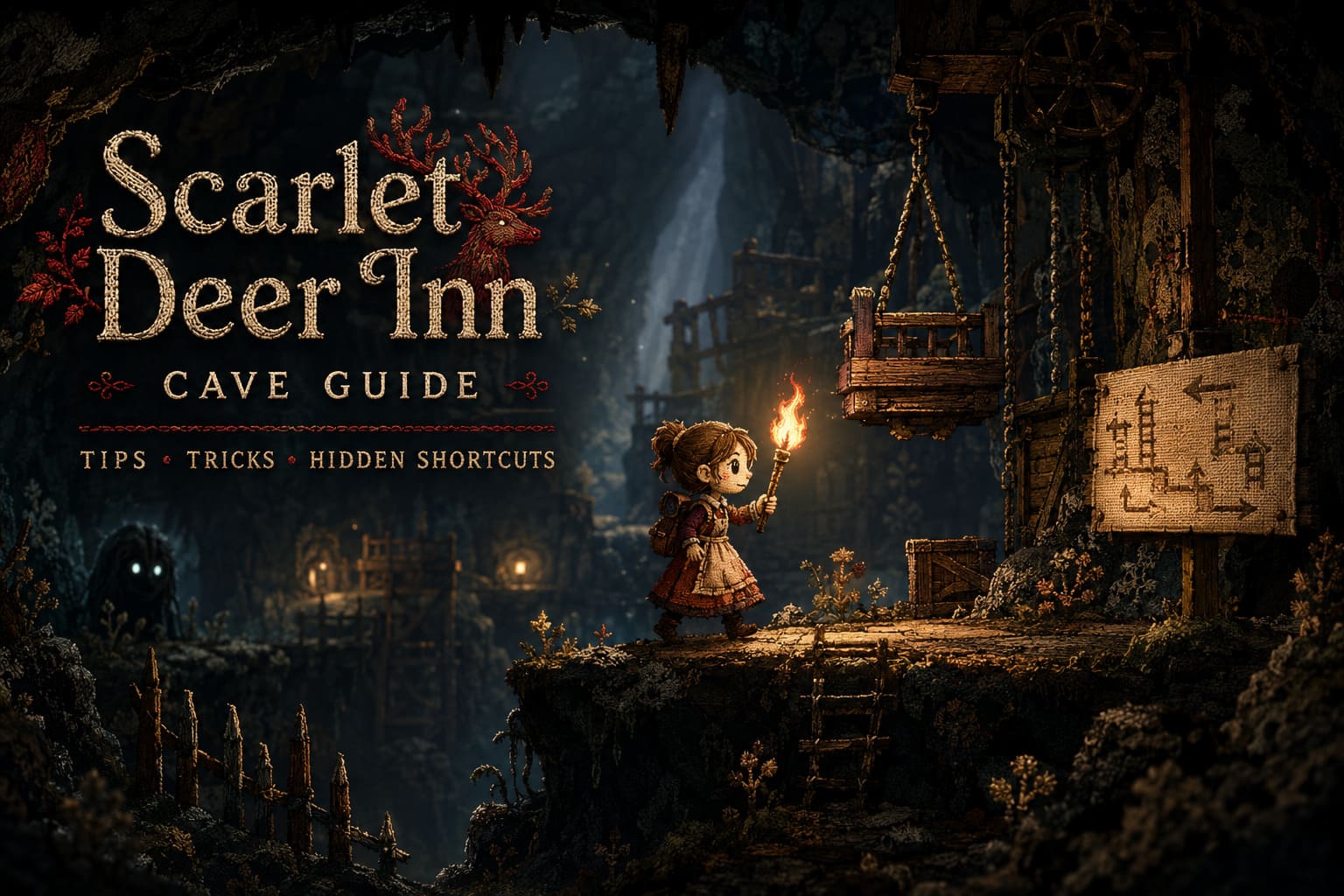
One thing I immediately appreciated is that the underground isn’t simply another level with a darker color palette. It feels like an entirely different game.
Instead of casually exploring villages, talking to NPCs, and enjoying the incredible handcrafted artwork, you’re suddenly managing limited visibility, listening for audio cues, solving environmental puzzles, and escaping creatures that are far stronger than Elise.
That’s actually one of my favorite design decisions.
Elise isn’t a legendary hero carrying magical weapons. She’s an ordinary mother trying to survive impossible circumstances. Because of that, every dangerous encounter feels believable instead of exaggerated.
The caves constantly remind you that survival—not combat—is your primary objective.
Your Torch Is More Important Than You Think
If there’s one mechanic that deserves your full attention, it’s the torch.
It isn’t just there to make the caves look atmospheric. It’s essentially your lifeline.
Without its light you lose the ability to read the environment properly. Spikes become invisible, gaps blend into darkness, and hidden paths become almost impossible to notice.
I learned pretty quickly that standing still is rarely a good idea. Every second your torch burns brings you closer to complete darkness.
A few habits helped me enormously:
- Always know where you’re going before moving.
- Avoid unnecessary backtracking whenever possible.
- Relight your torch whenever the opportunity appears.
One small detail I really liked is how the game builds tension through sound. As your light begins fading, the audio becomes increasingly stressful. Instead of flashing giant warning messages on screen, Scarlet Deer Inn lets the atmosphere do the work.
That subtle design choice makes every expedition feel far more immersive.
Don’t Ignore Dead Ends
Most platformers teach players that reaching a dead end simply means turning around.
Scarlet Deer Inn doesn’t always follow that rule.
Some of the most valuable discoveries are hidden exactly where you expect nothing to happen.
I’ve found myself walking away from suspicious corners only to return later and realize there was a hidden mechanic sitting right in front of me.
Watch for environmental clues such as:
- Cracked wooden flooring.
- Unusual wall textures.
- Isolated platforms.
- Boxes that seem oddly placed.
If something looks slightly different from everything around it, there’s usually a reason.
Sometimes jumping repeatedly on weakened flooring reveals another route below. Other times you’ll uncover shortcuts that permanently improve navigation after future deaths.
Those hidden passages save far more time than you’d expect.
Environmental Puzzles Are Simpler Than They Look
Fortunately, Scarlet Deer Inn doesn’t rely on overly complicated puzzle design.
Most solutions come down to observing your surroundings instead of searching for obscure clues.
Movable crates are especially useful.
Whenever a platform feels just barely out of reach, stop looking upward and start looking behind you. There’s often a wooden box nearby waiting to become a temporary staircase.
Likewise, don’t assume every lever or ladder only matters once.
Several interactions permanently unlock faster routes through earlier sections, making future attempts significantly less frustrating.
That kind of level design rewards exploration without feeling unfair.
Monster Encounters Reward Patience
One mistake I made early was assuming every monster required fast reactions.
In reality, many enemies are surprisingly predictable.
Instead of charging forward, spend a few seconds watching how they move.
Most creatures follow repeating patrol patterns.
Once you recognize their rhythm, crossing dangerous areas becomes much easier.
This is especially true when your torch barely reaches the edge of their patrol zone.
Rather than revealing every threat immediately, the game allows you to notice movement first. That split second of observation often determines whether you survive.
It’s also worth remembering that Elise isn’t built for combat.
Running away is usually the smartest decision.
And honestly? That fits the tone of the story much better than turning her into an action hero.
Chase Sequences Can Feel Brutal—Until You Understand Them
Some of the game’s most memorable moments happen during timed escape sequences.
The music changes. The environment becomes chaotic. Suddenly every jump feels twice as difficult.
My advice is surprisingly simple: ignore everything except your next platform.
The more you think about what’s chasing you, the more likely you’ll mistime a jump.
Almost every failure I experienced came from panicking rather than misunderstanding the route.
Scarlet Deer Inn wants you to stay calm under pressure.
Once you stop rushing your inputs, these scenes become much more manageable.

The Elevator Area Is Where Many Players Get Lost
If there’s one location I’ve seen mentioned repeatedly among players, it’s the multi-level elevator section.
At first glance, every staircase seems identical. You can spend ages walking in circles without realizing you’ve missed the correct route.
Here’s the approach that finally worked for me.
| Area | What To Do | Why It Matters |
|---|---|---|
| Upper-left staircase | Explore this route first. | Leads toward vertical progression. |
| Narrow platforms | Make careful side jumps. | Opens access to hidden paths. |
| Bottom-left section | Inspect the wooden floor. | Hidden breakable area below. |
| Newly opened passage | Continue downward. | Advances the main story. |
The important thing here isn’t speed.
Slow down.
Observe each room carefully.
The solution relies much more on exploration than complicated puzzle solving.
Always Watch for Interaction Prompts
Because Scarlet Deer Inn mixes embroidered characters with richly painted environments, interactive objects occasionally blend into the scenery.
That’s beautiful from an artistic perspective.
Gameplay-wise? Not always.
I occasionally walked past important interactions simply because they looked like decorative background details.
Whenever Elise pauses near an object, pay attention to any small interaction indicator.
That tiny prompt could reveal:
- A hiding place.
- A hidden switch.
- A ladder.
- A shortcut.
- A quest interaction.
Checking every suspicious object only takes a second, but it can save several minutes of unnecessary wandering.
Small Habits That Made My Playthrough Much Easier
These simple routines consistently improved my survival rate:
- Keep your torch lit whenever possible.
- Explore before assuming you’re stuck.
- Look for damaged flooring and unusual walls.
- Push every movable object you find.
- Unlock shortcuts as soon as they become available.
- Watch enemy patterns instead of rushing forward.
None of these tips feel revolutionary on their own.
Together, though, they dramatically reduce frustration during the underground chapters.
Scarlet Deer Inn Lore Explained: Who is Elise and What Secrets Hide Below?
What Makes These Caves Stand Out
I’ve played plenty of indie platformers over the years, and it’s surprisingly difficult to make underground exploration memorable.
Many games simply darken the screen and call it a cave.
Scarlet Deer Inn goes much further.
The lighting constantly affects decision-making.
Sound becomes part of navigation.
Exploration rewards curiosity rather than luck.
Most importantly, the handcrafted presentation never stops being impressive. Even while you’re desperately searching for the next safe light source, it’s hard not to admire the stitched character animations and painterly environments.
It’s a strange combination of beauty and anxiety that very few indie games manage to balance successfully.
Scarlet Deer Inn Release Date: When Is It Coming to Xbox Series X and Nintendo Switch?
Final Thoughts
The underground chapters of Scarlet Deer Inn ended up becoming some of my favorite moments in the entire adventure.
They’re tense without feeling unfair, mysterious without becoming confusing, and challenging without relying on cheap difficulty spikes.
If I could offer one piece of advice above everything else, it would simply be this:
Slow down.
The caves constantly reward careful observation. Hidden passages, environmental clues, enemy patrols, and permanent shortcuts are easy to miss if you’re sprinting through every room.
Once I started treating each area like a puzzle instead of an obstacle course, everything clicked.
Scarlet Deer Inn isn’t trying to overwhelm players with impossible platforming. It’s encouraging you to pay attention, trust your instincts, and appreciate the remarkable world Attu Games has created beneath the peaceful village.
Take your time, keep the torch burning, and don’t be afraid to investigate every suspicious corner. Chances are the game’s best secrets are hiding exactly where most players decide to turn back.