Corsair Cove Optimal Settings Guide: Max FPS on RTX 4060 Laptop
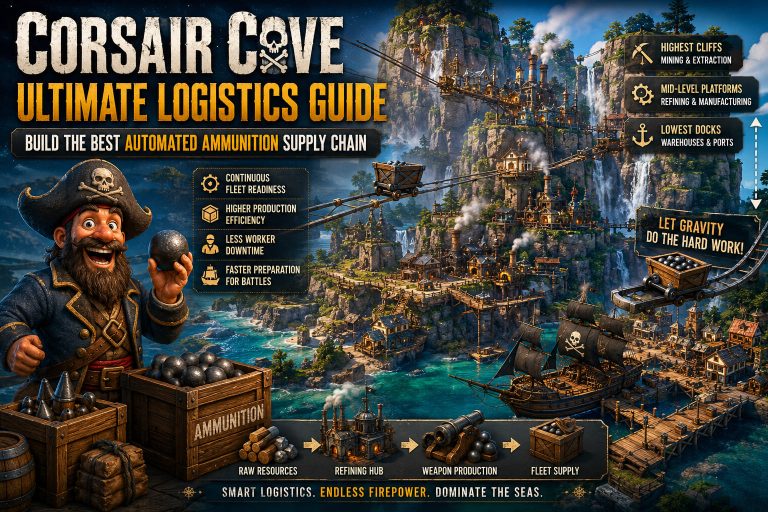
City builders have always been my weakness, especially the ones that make you think five steps ahead instead of simply placing buildings wherever there’s empty space. Corsair Cove instantly grabbed my attention because it doesn’t play like another cookie-cutter colony simulator. Building an entire pirate settlement across cliffs, connecting production chains with vertical paths, and defending everything from the Crown creates a surprisingly demanding experience for both your brain and your hardware.
I tested plenty of management games on an RTX 4060 Laptop over the past couple of years, and they all follow the same pattern. Everything feels effortless during the first hour, then your population grows, production chains multiply, ships start moving everywhere, and suddenly your frame rate isn’t nearly as impressive as it was when your town consisted of three wooden huts and a dock.
The good news is that the RTX 4060 Laptop GPU has more than enough horsepower for Corsair Cove. The trick isn’t brute force—it’s finding the right balance between image quality and performance. Fortunately, you don’t have to sacrifice the game’s beautiful tropical atmosphere to keep everything running smoothly.
Hell Let Loose: Vietnam Low FPS Fix – Best PC Settings for NVIDIA RTX Cards (2026 Guide)
Why Corsair Cove Gets More Demanding Over Time
Unlike many strategy games where the GPU does most of the work, Corsair Cove slowly shifts the workload as your settlement expands. At first, your graphics card barely breaks a sweat. Once dozens of production routes, citizens, ships, and defensive systems are all operating simultaneously, your processor suddenly has far more calculations to perform every second.
That’s why players often notice perfectly smooth gameplay during the early campaign, followed by random stutters several hours later. It isn’t necessarily poor optimization—it’s simply the nature of a simulation that keeps adding new systems until your pirate empire becomes a living machine.
The biggest performance drains usually include:
- Dynamic shadows
- Large population counts
- Long-distance object rendering
- Water reflections
- Heavy naval battles
Understanding these bottlenecks makes tweaking the graphics menu much easier.

Recommended RTX 4060 Laptop Settings
After experimenting with similar strategy titles and comparing community experiences, I’d recommend this setup for 1080p or 1200p gaming.
| Setting | Recommended Value |
|---|---|
| Display Mode | Fullscreen |
| Resolution | Native Resolution |
| DLSS | Quality |
| Frame Generation | Enabled |
| Texture Quality | High |
| Shadow Quality | Medium |
| Global Illumination | High |
| Water Quality | Medium |
| Reflections | Medium |
| View Distance | Medium |
| Population Density | Medium |
| Post Processing | Low or Off |
This configuration keeps visuals looking sharp while avoiding the unnecessary GPU load caused by a few expensive graphical effects.
DLSS Is Easily the Biggest Performance Upgrade
If there’s one setting I wouldn’t disable, it’s DLSS.
I’ve seen people insist on native resolution because they assume it always looks better, but with modern DLSS Quality mode that’s becoming harder to justify. Image quality remains extremely clean, UI elements stay crisp, and the FPS improvement is immediately noticeable.
Since Corsair Cove includes plenty of detailed menus, production icons, and small interface elements, I was pleasantly surprised by how little visual difference there is between native rendering and DLSS Quality.
Instead of wasting GPU resources rendering every pixel, let the RTX 4060’s Tensor Cores do what they’re designed for.
Frame Generation Makes Late-Game Much More Enjoyable
Management games rarely stress only the graphics card. Eventually the CPU becomes the limiting factor, especially once hundreds of units are updating simultaneously.
That’s exactly where Frame Generation helps.
During busy harbor scenes with multiple ships exchanging cannon fire while workers continue transporting resources across the city, the additional generated frames noticeably improve smoothness. Even when the actual frame rate dips, gameplay feels considerably more responsive.
Some players dislike Frame Generation in competitive shooters because of latency concerns, but Corsair Cove isn’t a fast-paced esports title. Here, smoother camera movement matters far more than shaving a few milliseconds from your input delay.
Shadows Are the First Setting I’d Lower
Every modern game seems obsessed with ultra-detailed shadows, but Corsair Cove pushes them even further because settlements aren’t flat.
- Buildings stack vertically.
- Bridges cast shadows onto cliffs.
- Trees overlap with rope walkways.
- Watchtowers project long shadows over several elevation levels.
All of this requires continuous lighting calculations, and that’s expensive.
Moving Shadow Quality from High or Ultra down to Medium barely changes the overall appearance while recovering a surprising amount of performance. During large settlements, it’s one of the easiest FPS gains you’ll find.
Water Looks Great Even Without Ultra Settings
Considering you’re managing a pirate settlement, the ocean is almost always visible.
Fortunately, this is another area where lowering quality doesn’t ruin the experience.
Ultra reflections produce gorgeous screenshots, but while you’re actually managing production chains or fighting enemy fleets, you’re rarely paying attention to perfect mirror-like water surfaces.
Setting both Water Quality and Reflections to Medium preserves the vibrant tropical aesthetic while giving your GPU additional breathing room.
Honestly, after a few minutes of gameplay I completely forgot I wasn’t running everything on Ultra.

High Textures Are Worth Keeping
This is one area where I’d avoid unnecessary compromises.
The RTX 4060 Laptop comes equipped with 8 GB of VRAM, which is generally enough for High textures at 1080p.
Detailed cliffs, colorful pirate clothing, weathered ships, docks, and rocky coastlines all benefit from higher-resolution textures. Unlike shadows or reflections, lowering textures usually doesn’t improve FPS very much unless your video memory is already full.
So unless you’re experiencing VRAM-related issues, leave Texture Quality on High.
Medium View Distance Is the Sweet Spot
One setting that’s often overlooked is View Distance.
At Ultra, the game continues rendering tiny environmental details and distant worker animations across enormous sections of the map. It looks impressive when you’re zoomed all the way out, but it also means your system is processing details you probably won’t even notice during normal gameplay.
Medium keeps major landmarks, production buildings, and terrain perfectly visible while trimming unnecessary background activity.
It’s one of those settings where the performance improvement is larger than the visual downgrade.
Don’t Ignore Laptop Performance Settings
I’ve lost count of how many people buy gaming laptops only to accidentally play everything using conservative power profiles.
A few quick adjustments outside the game can make just as much difference as changing graphics settings.
Here’s what I always recommend:
- Keep your charger connected while gaming.
- Switch your laptop to Performance or Turbo mode.
- Use the dedicated NVIDIA GPU instead of integrated graphics.
- Set NVIDIA Power Management to Prefer Maximum Performance.
- Close unnecessary background applications before launching the game.
These changes won’t magically double your FPS, but together they help your hardware maintain higher clock speeds during long building sessions.
CPU Matters More Than Many Players Expect
One thing I’ve learned from games like Factorio, Cities: Skylines, Manor Lords, and now Corsair Cove is that throwing a stronger graphics card at the problem doesn’t solve everything.
Late-game performance depends heavily on simulation speed.
- Every worker transporting supplies.
- Every ship plotting a course.
- Every production building calculating resources.
- Every citizen following their routine.
All of those systems rely on your processor just as much as your GPU.
That’s why lowering CPU-heavy options like shadows, population density, and long-distance rendering usually provides better overall stability than simply reducing texture quality.
My Final Thoughts
Corsair Cove is exactly the kind of strategy game that quietly steals your entire evening. You tell yourself you’ll optimize one production chain, then suddenly it’s midnight because you’ve redesigned half the coastline and built another harbor district. That’s also when performance starts becoming more important than visual perfection.
For an RTX 4060 Laptop, I think the smartest approach is keeping the image clean with High textures, DLSS Quality, and Frame Generation, while cutting back on the settings that offer the smallest visual payoff, especially shadows, reflections, and excessive view distance. The game still looks fantastic, but your frame rate stays much more consistent as your pirate empire grows into a sprawling industrial fortress overlooking the sea.
Rather than chasing Ultra presets just because they’re available, focus on stability. A smooth city builder is simply more enjoyable, especially once your settlement becomes the bustling pirate capital you’ve spent hours creating.