Minecraft Dungeons 2 Armor Guide: Best 4-Piece Sets and Combinations
If there is one thing I was hoping Minecraft Dungeons 2 would finally get right, it was build variety. The original game had plenty of fun loot, but armor could sometimes feel like you were simply hunting for the next better version of the same basic idea. The sequel takes a much bigger swing.
With the September 29, 2026 launch of Minecraft Dungeons 2, armor is no longer one big package. Instead, your character gets four separate defensive slots: Helmet, Chestplate, Leggings, and Boots. And honestly, this changes much more than I expected.
You can still chase complete sets for powerful bonuses, but you can also break those sets apart and create combinations that fit exactly how you like to play. Want a heavily armored brawler who can still move quickly? You can build one. Prefer a mobile character who jumps into a group, causes chaos, and disappears before the counterattack? That’s possible too.
After looking at how the system comes together, these are the armor combinations and mechanics I’d be paying the most attention to.
The New Four-Piece Armor System Explained
The biggest change is pretty straightforward: armor is now divided into four individual pieces.

Each slot has its own job, and understanding that role is the first step toward making a good build.
| Armor Slot | Main Role | Build Focus |
|---|---|---|
| Helmet | Utility and resources | Artifact cooldowns, souls, targeting |
| Chestplate | Main defense | Health, damage reduction |
| Leggings | Secondary defense | Agility, resistance, elemental effects |
| Boots | Mobility | Movement, dodge recovery, jump bonuses |
This might sound like a simple inventory change, but it creates a completely different approach to gearing.
In the old system, finding a great armor piece could mean committing to its entire package. In Minecraft Dungeons 2, one chestplate can become the foundation of your build while your helmet, leggings, and boots come from completely different gear families.
That’s where things get interesting.
Full Sets Are Powerful, But You Don’t Always Need One
Naturally, Mojang isn’t going to give us four independent armor slots without a reason to actually match them.
Gear families have set bonuses, with additional effects unlocking when you equip multiple pieces from the same family.
A typical progression works like this:
- 2 pieces: A smaller bonus that reinforces the set’s primary purpose.
- 4 pieces: A major capstone effect that can dramatically change how the build plays.
And this is where I think players are going to have the most fun.
A full four-piece set is the obvious choice when you want to maximize a specific playstyle. But the 2-piece bonuses create an entirely different layer of experimentation.
For example, you could take the defensive benefits of Darkstone Gear on your Helmet and Chestplate, then equip Swiftfoot Leggings and Boots to compensate for the slower, heavier playstyle.
Suddenly, you’re not just a tank.
You’re a tank that can actually move.
That kind of hybridization is exactly what I want from an action RPG.
My Favorite Approach: Build Around Two-Piece Synergies
Personally, I’d avoid automatically equipping four pieces from the same set just because the game tells me the 4-piece bonus is powerful.

Sometimes a 2+2 combination can make more sense.
Imagine a build like this:
Darkstone Helmet + Darkstone Chestplate
Swiftfoot Leggings + Swiftfoot Boots
The Darkstone pieces give you the defensive foundation, while the Swiftfoot pieces focus on mobility.
That combination should be particularly useful in the new connected world, where positioning matters more than simply standing in one place and absorbing damage.
This is especially relevant because Minecraft Dungeons 2 introduces more vertical movement and a dedicated jump mechanic. Movement isn’t just cosmetic anymore. It becomes part of combat.
Goat Armor: The Jumping Specialist
The first set that immediately caught my attention is Goat Armor.
This gear family is built around the new vertical movement mechanics. Individual pieces improve things such as jump height and fall-damage mitigation, which sounds niche until you remember how much more important movement is becoming.
The four-piece bonus is where things get crazy.
A specialized jump attack into a group of enemies can trigger a powerful knockback shockwave, turning your movement ability into an actual crowd-control tool.
I can already imagine the gameplay loop:
Jump into the middle of a mob → trigger the attack → send enemies flying → reposition → repeat.
It looks like exactly the kind of set that will reward aggressive players instead of people who sit behind a wall and spam ranged attacks.
Best For
- Crowd control
- Aggressive melee builds
- Vertical exploration
- Players who enjoy movement-heavy combat
The unique variants, including Golden Goat Gear and Queen’s Pelt, should also be interesting targets for players chasing more specialized versions of the archetype.
Darkstone Gear: The Tank’s Best Friend
If Goat Armor is about movement, Darkstone Gear goes in almost the opposite direction.
This is the set I’d look at when I want to stand in front of my friends and basically tell the enemies, “You’re going through me first.”
Darkstone focuses heavily on damage reduction and health, giving it an obvious frontline identity.
Its four-piece bonus takes that defensive concept even further by creating a barrier capable of absorbing incoming projectile damage and reflecting part of it back as explosive energy.
That’s a particularly nice combination for multiplayer.
Instead of defense simply meaning “I take less damage,” the set can potentially turn enemy attacks into another source of damage.
Best For
- Tanks
- Multiplayer frontline builds
- High-health characters
- Players who prefer defensive play
The Prime Armor and Nova Armor variants are also worth watching if you’re specifically hunting for high-end defensive gear.
Gauntlet Armor: For Players Who Just Want to Punch Things
Then there’s Gauntlet Armor, which is probably the set I’d gravitate toward when I get tired of being responsible.
This family is designed around close-range combat, attack speed, and critical hits.
Individual pieces increase melee attack speed and provide lifesteal-style benefits tied to critical hits. That already gives the set a strong identity, but its four-piece bonus pushes it into boss-killing territory.
The capstone increases melee reach while applying cumulative armor-shredding effects to bosses and elite enemies.
That’s a pretty attractive setup for anyone who wants to focus on single-target DPS.
You aren’t trying to control the battlefield.
You’re trying to delete the biggest thing on it.
The unique variants, such as Xavier’s Return and Corruption Armor, should be especially interesting for players building dedicated melee characters.
Full Set vs. Hybrid Build: Which Should You Use?
There isn’t one universal answer, and that’s probably the best part of this system.
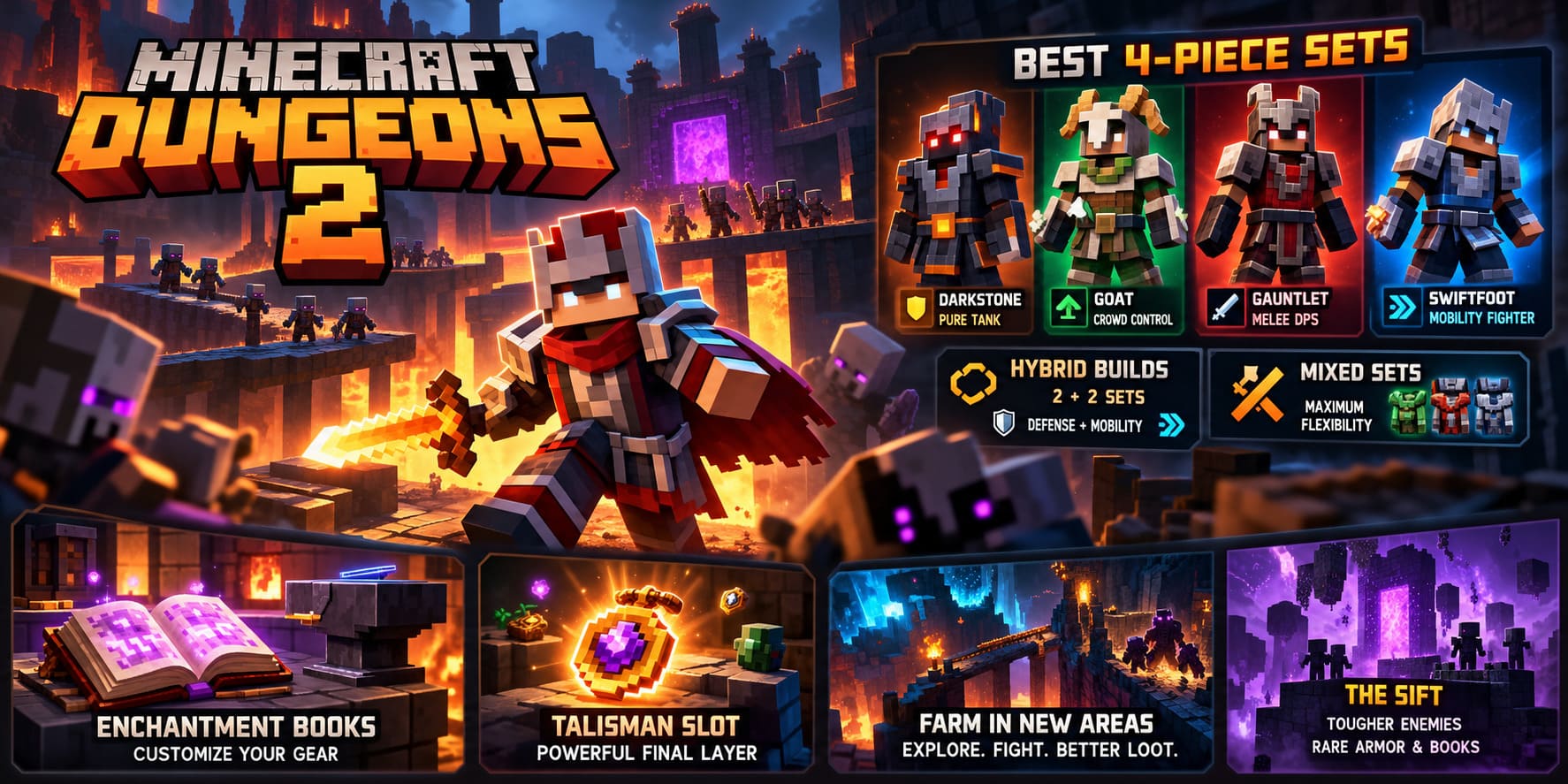
| Build Type | Recommended Approach | Why |
|---|---|---|
| Pure Tank | 4-piece Darkstone | Maximum defensive specialization |
| Mobility Fighter | 2 Goat + 2 Swiftfoot | Movement without sacrificing all defense |
| Melee DPS | 4-piece Gauntlet | Attack speed and armor shredding |
| Crowd Controller | 4-piece Goat | Jump attacks and knockback |
| Hybrid Defender | 2 Darkstone + 2 mobility pieces | Defense with better positioning |
| Experimental Build | Mixed sets | Maximum flexibility |
For me, the 2+2 setups are the most exciting part.
A complete set gives you a clear identity, but hybrid armor makes you think about why every individual item is in your inventory.
That’s when gear stops being something you replace every few hours and starts becoming part of your character.
Enchantment Books Completely Change the Equation
Armor isn’t the only system getting an overhaul.
Enchantment Books are also changing how players customize equipment.
Instead of relying entirely on whatever enchantments happen to appear on a dropped item, you can collect books and apply them through the town’s blacksmith or anvil system.
That sounds like a small quality-of-life improvement, but it could have a huge impact on progression.
Let’s say you finally find the perfect Unique Chestplate. The stats are exactly what you want, but the enchantments aren’t.
In the original game, that could mean continuing to farm and hoping RNG eventually gives you another great drop.
Here, you can potentially keep the armor and customize it with the Enchantment Books you’ve collected.
That’s the kind of progression system that makes farming feel less frustrating.
Instead of throwing away good gear because one random stat isn’t perfect, you have more control over turning it into something that fits your build.
Don’t Ignore the Talisman Slot
There’s also a completely separate Talisman slot, and I think this could become one of the most important parts of high-level builds.
Your armor establishes the basic structure of your character: health, defense, mobility, and set bonuses.
Talismans can then act as the finishing layer.
For example, a Soul-binding Talisman could pair extremely well with a soul-focused armor setup, turning collected souls into additional survivability or temporary offensive buffs.
So your final build isn’t simply:
Helmet + Chestplate + Leggings + Boots
It’s more like:
Armor Set + Enchantments + Talisman + Weapons + Artifacts
That’s a much more traditional ARPG approach, and I’m very happy to see Minecraft Dungeons 2 leaning into it.
How to Farm the Armor You Actually Want
The new connected world also changes how you’ll approach farming.
Rather than selecting another isolated mission from a menu, you’re exploring a larger world where different regions can offer different loot opportunities.
If you’re specifically hunting Darkstone Gear, for example, subterranean areas, rocky regions, and deeper dungeons should be your priority rather than simply running random forest areas and hoping for the best.
Then there’s The Sift.
This new dimension looks like one of the major destinations for endgame players. The enemies are tougher, including heavily buffed Illager variants, but the rewards are also more valuable.
Rare armor variants and powerful Enchantment Books make these dangerous areas worth the risk.
And honestly, this is where I expect the most serious build experimentation to happen.
Minecraft Dungeons 2 Best 4-Player Co-Op Team Builds (2026 Meta Guide)
Don’t Throw Away Lower-Power Armor
One thing I’d strongly recommend is not immediately dismantling an armor piece just because its item power is lower than your current equipment.
The blacksmith can apparently help scale favorite gear as you progress, allowing players to keep using carefully optimized equipment instead of constantly abandoning it for higher-level drops.
That’s huge for build-focused players.
If you’ve spent hours finding the right four-piece combination and then customized it with the perfect enchantments, you don’t want the entire setup becoming useless simply because your character leveled up.
The ability to maintain your favorite gear should make long-term build crafting much more rewarding.
Minecraft Dungeons 2 Crossplay Guide: How to Play Multi-Platform Co-Op Multiplayer
Final Thoughts
The new armor system might be the feature I’m most interested in with Minecraft Dungeons 2.
Splitting armor into Helmets, Chestplates, Leggings, and Boots sounds simple on paper, but once you add 2-piece bonuses, 4-piece capstones, Enchantment Books, Talismans, Unique variants, and the ability to upgrade older gear, the number of possible builds gets enormous.
Personally, I wouldn’t rush straight toward a complete four-piece set.
I’d experiment.
Try two Darkstone pieces with mobility gear. Build around Goat Armor and see how far the new jump mechanics can take you. Go all-in on Gauntlet Armor if you want to turn every elite enemy into a punching bag. Then start adding Talismans and Enchantment Books to see where the build breaks — or becomes surprisingly powerful.
That’s what makes a loot-driven game memorable for me.
The best armor isn’t necessarily the armor with the biggest numbers. It’s the armor that makes your character play exactly the way you want.
And with Minecraft Dungeons 2 finally giving players four separate armor slots, there should be plenty of room to experiment.